

September 1, 2026
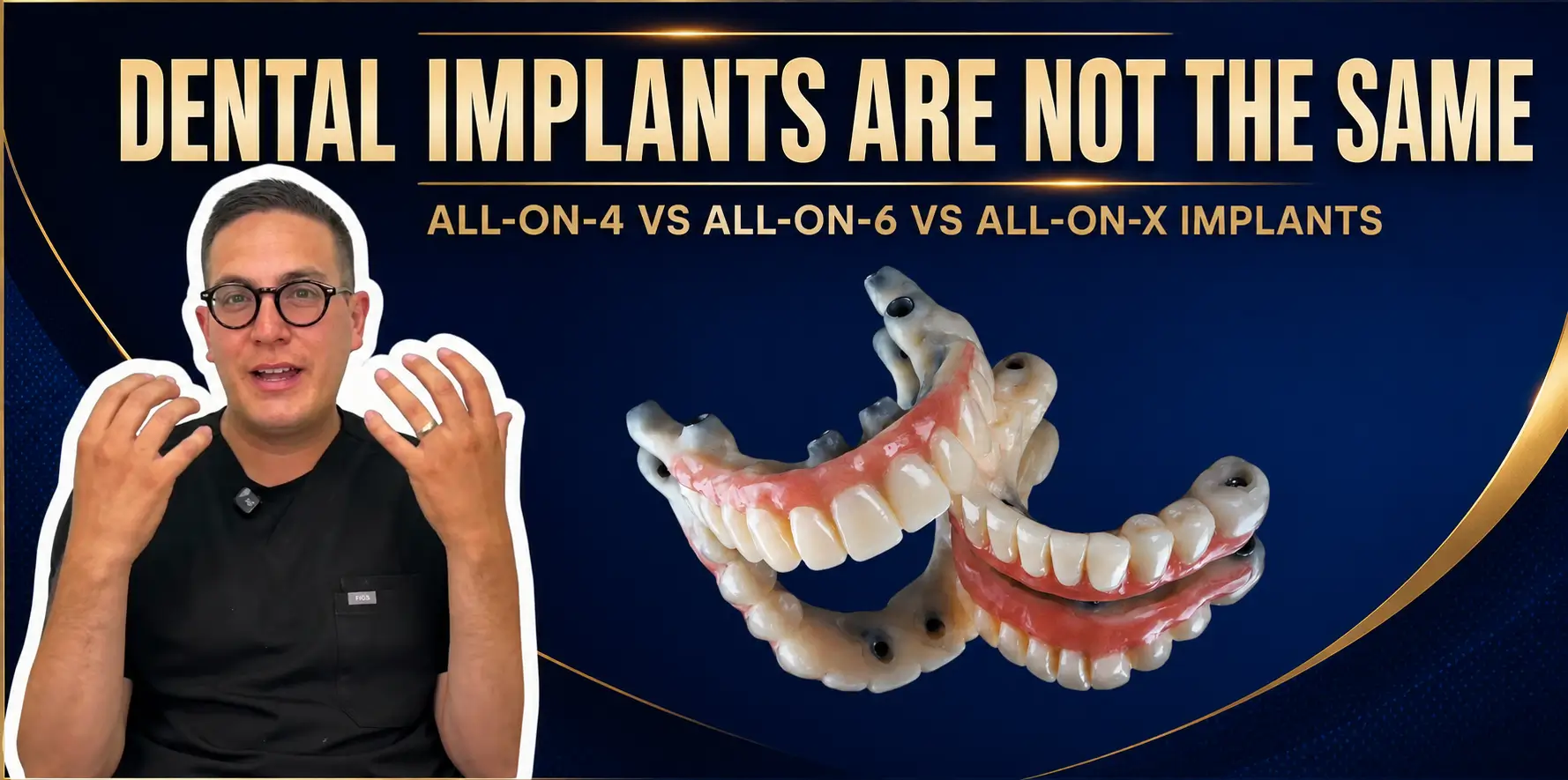
If you are missing most or all of your teeth—or you have failing teeth that may need to be replaced—you may have already come across terms like All-on-4, All-on-6, and All-on-X dental implants.
But what is the difference?
Is six implants automatically better than four? What does the “X” in All-on-X actually mean? And can any of these treatments really give you a new set of teeth in just one day?
The answer depends on something much more important than a number: your individual anatomy, bone quality, bite, health, and long-term treatment goals.
At Lasting Smiles Dental Implant Center, full-arch implant treatment is planned around the patient rather than trying to make every patient fit into the same implant configuration.
In this guide, we’ll explain All-on-4 vs All-on-6 vs All-on-X dental implants, when more implants may be recommended, what happens if you have bone loss, how same-day teeth work, and what you should know before choosing a full-arch dental implant treatment.
What Are Full-Arch Dental Implants?
Full-arch dental implants replace an entire upper or lower row of teeth using several strategically placed implants. Instead of one implant per tooth, a few implants support a fixed bridge, offering a stable alternative to removable dentures. This option suits those with significant tooth loss, failing teeth, or uncomfortable dentures who want a fixed, full-arch solution. Depending on your needs, your dentist may recommend four, six, or more implants to support your new teeth, leading to options like All-on-4, All-on-6, and All-on-X.
Instead of placing one implant for every missing tooth, a carefully selected number of implants support a complete fixed bridge.
For many patients, this can provide a more stable alternative to traditional removable dentures.
A full-arch implant restoration may be considered for people who:
- Are missing most or all of their teeth
- Have severely damaged or failing teeth
- Are tired of loose or uncomfortable dentures
- Have difficulty chewing because of missing teeth
- Want a fixed solution rather than a removable denture
- Want to restore an entire upper or lower arch
- Want to explore same-day or Teeth-in-a-Day treatment options
Depending on your anatomy and treatment plan, your dentist may recommend four, six, or another number of implants to support your new teeth.
That is where All-on-4, All-on-6, and All-on-X come in.
1. What Are All-on-4 Dental Implants?
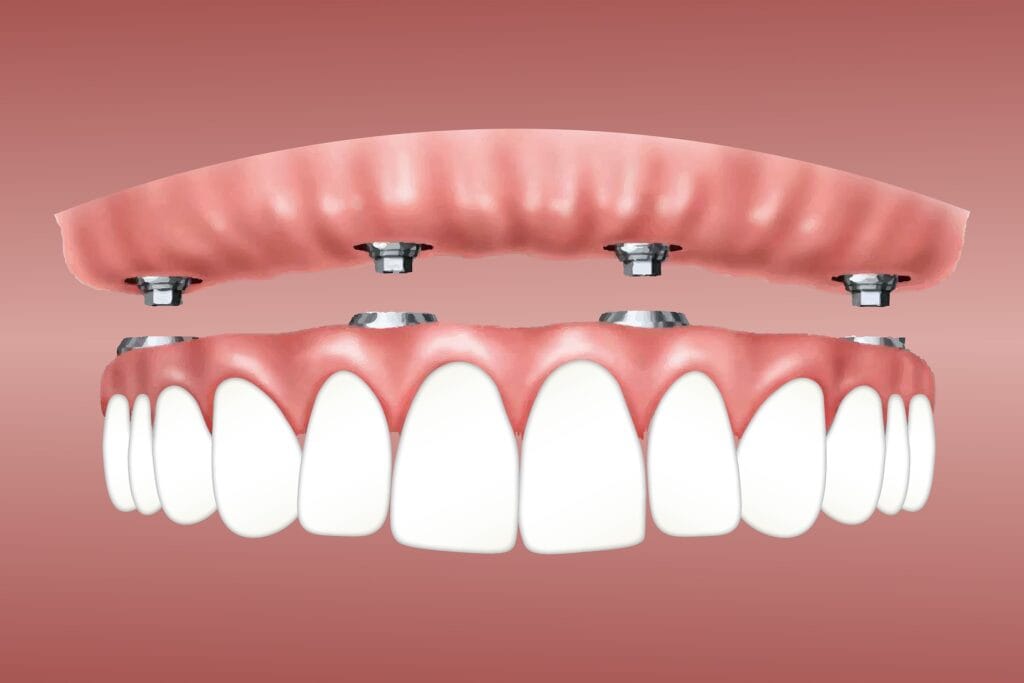
All-on-4 dental implants use four dental implants to support a complete arch of replacement teeth.
Typically, the front implants are placed vertically in denser bone, while the implants are strategically distributed across the jaw to create a stable foundation for the full-arch bridge. In some cases, the back implants may be positioned at an angle to take advantage of available bone and help avoid anatomical structures, which can help reduce the need for certain bone grafting procedures.
The goal is to create sufficient support using only four implants. This treatment concept is often considered cost-effective because it uses fewer implants and less hardware than some traditional full-arch approaches.
Reported implant survival for the All-on-4 treatment is about 98%, and more than 250,000 patients have been treated.

Potential advantages of All-on-4 include:
- Fewer implants compared with some other full-arch configurations
- Ability to replace an entire arch
- Strategic use of available jawbone
- Same-day fixed temporary teeth may be possible for qualifying patients
- Fewer individual implant sites
- Potentially less complex treatment in selected cases
However, four implants are not automatically the ideal number for every patient.
Bone density, bite strength, jaw anatomy, implant position, and the length of the final bridge all need to be evaluated.
This is one reason advanced imaging and treatment planning are so important.
2. What Are All-on-6 Dental Implants?
All-on-6 dental implants use six implants rather than four to support a full-arch restoration.
The concept is similar: multiple implants are distributed throughout the jaw and connected to a fixed bridge.
Adding two additional implants may give the dentist more options for distributing biting forces across the arch.
For certain patients, six implants may also provide additional support or allow implants to be positioned more favorably based on available bone.

Potential advantages of All-on-6 include:
- Six supporting implants across the arch
- Greater distribution of biting forces
- More flexibility when positioning implants
- Additional support points for a full-arch restoration
- May help reduce the amount of unsupported bridge extending behind the final implant
- May be preferred for certain anatomical situations
But this does not mean All-on-6 is automatically superior to All-on-4.
A well-planned four-implant restoration can be appropriate for one patient, while another patient may benefit from five, six, or even more implants.
The correct number depends on the individual case.
3. What Does All-on-X Mean?
All-on-X is a broader term describing a complete arch of teeth supported by a customized number of dental implants.
Think of the “X” as a variable.
It could mean:
- All-on-4
- All-on-5
- All-on-6
- Or another implant configuration recommended by your dentist
Instead of deciding before the examination that every patient must receive exactly four or six implants, the All-on-X approach allows the implant team to choose the number and positioning of implants based on the patient’s specific needs.
Factors that may influence that decision include:
- Available bone
- Bone density
- Upper versus lower jaw
- Jaw shape
- Location of nerves and sinus cavities
- Bite forces
- Teeth grinding or clenching
- Width and shape of the dental arch
- Overall health
- Long-term prosthetic design
For this reason, All-on-X can be considered a more individualized way of thinking about full-arch implant treatment.
4. All-on-4 vs All-on-6 vs All-on-X Comparison
Feature | All-on-4 | All-on-6 | All-on-X |
|---|---|---|---|
Number of implants | 4 implants per arch | 6 implants per arch | Customized, often 4–6+ |
Replaces a full arch | Yes | Yes | Yes |
Fixed teeth possible | Yes | Yes | Yes |
Same-day temporary teeth may be possible | Yes, if eligible | Yes, if eligible | Yes, if eligible |
Implant positioning | Planned around available bone | Six implants distributed throughout the arch | Fully customized |
Force distribution | Across 4 implants | Across 6 implants | Depends on implant number and position |
Bone requirements | Case dependent | Case dependent | Customized around anatomy |
Best for | Selected patients who can achieve adequate support with four implants | Patients who may benefit from additional implant support | Patients who need an individualized treatment plan |
Final restoration | Often zirconia or another full-arch material | Often zirconia or another full-arch material | Often zirconia or another full-arch material |
Treatment planning required | Yes | Yes | Yes |
So which option is best?
The answer cannot be determined from implant count alone.
The most appropriate treatment is the one that provides stable implant positioning, appropriate force distribution, sufficient bone support, and a prosthetic design that works with your anatomy and bite.
5. Why Do Some Patients Need More Than Four Implants?
Four implants can support a complete arch in appropriately selected patients. However, some patients may benefit from additional implants.
Your dentist may recommend five, six, or more implants because of factors such as:
Bone quality
Not all jawbone has the same density.
The upper jaw, for example, often contains softer bone than portions of the lower jaw. Implant stability therefore needs to be evaluated individually.
Bite forces
Patients with powerful bite forces, large jaw muscles, or a history of grinding or clenching may require a different approach.
Jaw anatomy
The width, height, and shape of the jaw influence where implants can safely and predictably be positioned.
Implant distribution
Sometimes placing additional implants allows the dentist to distribute support across a larger portion of the arch.
Prosthetic design
The final bridge has to be designed around the implants underneath it.
The number and position of implants can influence bridge length, support, and how forces are transferred when you chew.
Long-term treatment planning
Your implant dentist may determine that additional implants provide a more appropriate foundation for your particular restoration, because long-term treatment planning requires careful planning aimed at long term success. Choosing the right number and position of implants helps ensure optimal results over time.
The goal shouldn’t be to use the fewest or greatest number of implants.
The goal is to use the right number of implants for your mouth.
6. What Happens If There Isn’t Enough Bone for Dental Implants?
Having bone loss does not automatically mean you cannot receive dental implants, and when they are appropriately placed and restored, implant treatment can also help with preventing bone loss.
To determine how much bone is available, your implant dentist will typically evaluate your jaw using advanced 3D imaging such as a CBCT scan.
If there isn’t enough bone in an ideal implant location, treatment options may include:
- Bone grafting
- Sinus augmentation or sinus lift procedures
- Changing implant size or position
- Angled implants
- Using different areas of available bone
- A customized All-on-X configuration
- Additional surgical procedures when appropriate
Some bone grafts can be performed at the time implants are placed, while more significant bone deficiencies may require additional healing before implant placement.
The amount of bone available, along with prior dental problems, is one of the most important reasons why treatment should be designed after a complete examination—not based solely on a package labeled “All-on-4” or “All-on-6.”
7. Can All-on-X Give You Teeth in One Day?
For qualifying patients, yes—an All-on-X procedure may allow a fixed set of teeth to be attached shortly after implant placement, sometimes on the same day. For eligible patients, this approach can offer a quicker rehabilitation path to fixed teeth than traditional staged methods.
This is commonly referred to as:
- Teeth in a Day
- Same-Day Teeth
- Immediate Load Dental Implants
- New Teeth in One Day
- Full-Arch Immediate Loading
However, not every patient automatically qualifies.
For immediate fixed teeth to be considered, the implants need to achieve sufficient initial stability, and the dentist must evaluate factors such as bone quality, implant distribution, bite, medical history, and the design of the restoration.
At Lasting Smiles Dental Implant Center, advanced digital technology including 3D imaging and photogrammetry can be incorporated into full-arch treatment planning and restoration fabrication.
Patients who qualify may be able to arrive with missing or failing teeth and leave with a fixed set of teeth attached to their newly placed implants.
It is important, however, to understand the entire process, from the teeth placed around the day of surgery to the final restoration.
8. Temporary Teeth vs Final Zirconia Teeth
One of the biggest misunderstandings surrounding “Teeth in a Day” is the assumption that the restoration placed immediately after surgery is always the patient’s final bridge.
Often, the first fixed bridge is a temporary or provisional restoration designed to protect the implants and provide teeth while the implants heal and integrate with the jawbone.
Temporary Teeth
Your provisional teeth allow you to:
- Smile during the healing period
- Speak more naturally
- Eat an appropriate soft-food diet
- Evaluate the appearance of your new smile
- Allow your dentist to monitor your bite
- Allow gum tissues and implants to heal
Temporary teeth are used first in part to protect the implants during the healing process.
Patients are typically instructed to follow dietary restrictions during this stage because the implants are still healing.
Final Zirconia Teeth
After the implants have integrated and the surrounding tissues have stabilized, your final restoration is delivered as the prosthetic arch.
At Lasting Smiles Dental Implant Center, the in-house dental laboratory designs and fabricates implant-supported restorations using high-quality materials including zirconia.
Zirconia is frequently selected for full-arch restorations because it can provide:
- Excellent strength
- Natural-looking aesthetics
- Stain resistance
- A smooth surface
- Custom tooth shape and color for prosthetic teeth designed to function and look like natural teeth
- Long-term durability when properly maintained
Your dentist will determine which restorative material is most appropriate for your individual treatment.
9. How Long Does All-on-X Treatment Take?
There are really two different timelines to understand:
Your surgery day
For qualifying same-day patients, extractions, implant placement, and delivery of a fixed provisional bridge may occur during the same treatment period.
Your complete treatment timeline
The complete timeline begins with the initial consultation and continues through healing to the delivery of the final restoration.
This process is known as osseointegration.
Healing commonly takes several months, although every patient’s timeline is different.
During this period, your dentist monitors:
- Implant stability
- Gum healing
- Bite
- Comfort
- Oral hygiene
- Appearance and function of the provisional teeth
Once healing is sufficient, the final bridge can be designed, refined, and delivered, and following care instructions during healing supports optimal results and a successful outcome.
Patients who require extensive bone grafting or other procedures may have a longer overall treatment timeline.
10. What Sedation Options Are Available for Full-Arch Dental Implants?
Dental implant treatment can understandably cause anxiety, especially for patients who have avoided the dentist for years because of fear.
Sedation options can make full-arch implant procedures significantly more comfortable.
Depending on the patient’s health, treatment needs, and provider recommendations, sedation may include:
Nitrous oxide
Often called “laughing gas,” nitrous oxide helps patients relax while remaining conscious.
Oral sedation
Medication is taken before treatment to reduce anxiety and produce a deeper state of relaxation.
IV sedation
Medication is administered intravenously and can provide deeper sedation for more extensive procedures.
General anesthesia
For appropriately selected cases, general anesthesia may also be considered.
Lasting Smiles Dental Implant Center offers personalized sedation options including nitrous oxide, oral sedation, IV sedation, and general anesthesia.
Your provider will review your medical history before determining which form of sedation is appropriate.
To learn more about this check this separate article : How to Prepare for Sedation Dentistry
11. How Much Do All-on-4, All-on-6, and All-on-X Dental Implants Cost?
There isn’t one universal price for full-arch dental implants because every case is different.
Cost may depend on:
- Number of implants
- Whether one or both arches are treated
- Extractions
- Bone grafting
- Sinus procedures
- Sedation
- Type of temporary restoration
- Final restoration material
- Diagnostic imaging
- Complexity of the case
- Laboratory work
- Follow-up care
Learn More about General Cost Guide: 2026 Dental Implant Cost And Information Guide
This is why comparing dental implant treatment by advertised price alone can be misleading. Ask exactly what is included in the treatment plan. For example:
Does the quoted price include the final zirconia bridge?
Are extractions included?
Is sedation included?
Are bone grafts included?
Does the practice have its own lab?
Are there additional fees during the restorative phase?
Financing Options
Full-arch dental implants are a significant investment.
Lasting Smiles Dental Implant Center works with financing partners and offers flexible payment options for qualifying patients, allowing eligible patients to spread treatment costs over time rather than paying the entire amount upfront.
Financing availability, payment amounts, interest rates, and approval requirements vary.
During your consultation, the team can review available payment options based on your treatment plan.
Learn More about our Payment Plans
12. Who May Qualify for All-on-X Dental Implants?
You may be a potential candidate if you:
- Have multiple missing teeth
- Are missing an entire arch
- Wear dentures
- Have loose or uncomfortable dentures
- Have severely damaged or failing teeth
- Have advanced tooth loss
- Want a fixed alternative to removable dentures
- Have enough bone for implant placement or can receive additional procedures
- Are healthy enough for oral surgery
- Are willing to follow post-surgical instructions
- Can maintain appropriate oral hygiene
- Attend recommended follow-up and maintenance appointments
Patients with significant bone loss should not automatically assume they cannot receive implants.
Likewise, age alone does not determine candidacy.
Your medical history, medications, oral health, bone anatomy, healing ability, facial structure, and other factors all need to be evaluated when planning full-arch care.
The only reliable way to determine candidacy is through an initial consultation and diagnostic examination.
13. Why CBCT and Digital Implant Planning Matter
Full-arch implant surgery involves much more than simply placing implants into available space, especially in full arch rehabilitation.
Implants must be planned around important anatomical structures including:
- Jawbone
- Nerves
- Sinus cavities
- Adjacent anatomy
- Gum tissue
- Bite
- Final tooth position
A CBCT scan, or cone-beam computed tomography scan, creates a 3D image of the jaws and surrounding anatomy.
This gives the implant team information that traditional two-dimensional dental X-rays cannot provide on their own.
At Lasting Smiles Dental Implant Center, dental CT scanners provide detailed 3D imaging that can be used to plan implant placement.
Digital treatment planning can help the dentist determine:
- How much bone is available
- Appropriate implant length and diameter
- Potential implant positions
- Proximity to nerves and sinuses
- Angulation of implants
- Restorative space
- How the final teeth should relate to the implants
Lasting Smiles also uses technology such as 3D facial scanning and photogrammetry as part of its digital workflow for selected full-arch cases.
This allows the surgical and restorative sides of implant dentistry to work together from the beginning, helping preserve structural integrity over time.
14. Why an In-House Dental Lab Can Matter
Full-arch implant treatment combines two very different areas of dentistry:
- Surgical implant placement
- Designing and fabricating the teeth
Communication between the dentist and dental laboratory is extremely important. When a practice has an in-house dental lab, the clinical and laboratory teams can work more closely throughout the treatment process.
At Lasting Smiles Dental Implant Center, restorations including crowns, bridges, dentures, and implant-supported teeth can be designed and fabricated through its in-house lab.
Potential advantages include:
- Faster communication between the dentist and technician
- Greater control over restoration design
- Easier adjustments
- Digital collaboration
- Faster turnaround in certain situations
- More control over tooth shape and appearance
- Coordination between implant position and final bridge design
For full-arch treatment, that integration can be especially useful because the implants and the final teeth must function as a single system.
All-on-4 vs All-on-6 vs All-on-X: Which Should You Choose?
You shouldn’t have to choose the number of implants yourself when the real goal is finding the most appropriate permanent solution.
That decision should come after your implant dentist evaluates your:
- CBCT scan
- Bone quality
- Bone volume
- Jaw anatomy
- Bite
- Smile
- Existing teeth
- Medical history
- Restorative goals
For one patient, four implants may provide an appropriate foundation.
Another may benefit from six implants.
Someone else may need an entirely different All-on-X configuration, and the right design can improve daily function and quality of life.
The question therefore isn’t:
“Is All-on-6 better than All-on-4?”
A better question is:
“How many implants will give my new teeth the right foundation based on my anatomy?”
That is what personalized treatment planning is designed to answer.
Frequently Asked Questions About All-on-4, All-on-6 and All-on-X
Is All-on-6 better than All-on-4?
Not necessarily. Six implants provide additional implant support, but the correct number depends on your anatomy, bone quality, implant positions, bite, and restorative plan.
Some patients are excellent candidates for four implants while others may benefit from six or more.
What does the X mean in All-on-X?
The “X” represents a variable number of implants.
Instead of committing to exactly four or six implants before evaluating the patient, an All-on-X approach allows the implant team to select the number and location of implants appropriate for that individual case.
Can I get All-on-X implants if I have bone loss?
Possibly.
Many people considering full-arch implants have already experienced some degree of bone loss.
Depending on the location and severity of the bone loss, your dentist may recommend bone grafting, different implant positions, angled implants, sinus procedures, or another strategy.
A CBCT scan is required to properly evaluate your anatomy.
Can I get teeth the same day as my implants?
Some patients can receive a fixed provisional bridge on or shortly after the day their implants are placed.
This is called immediate loading or Teeth-in-a-Day treatment.
However, your implants must achieve sufficient initial stability and other clinical requirements must be met.
Not everyone qualifies.
Are same-day teeth permanent?
Your same-day restoration may be a fixed provisional bridge rather than the final zirconia restoration.
The provisional bridge allows the implants and tissues to heal while you have teeth.
After healing and osseointegration, the final restoration can be fabricated according to your treatment plan.
How many implants are needed for a full mouth?
It depends on whether one or both arches require treatment and the implant configuration chosen.
A full arch is commonly supported by four to six implants, and some All-on-6 cases use six dental implants to support the full arch, with the exact number chosen based on your anatomy rather than a fixed formula.
Are All-on-X teeth removable?
A fixed full-arch implant bridge is secured to dental implants and isn’t removed by the patient like a traditional denture.
Your dentist can remove the restoration when professionally necessary.
Other implant options, such as snap-on implant-supported dentures, are removable.
How long do All-on-X implants take to heal?
Osseointegration generally takes several months.
The healing process varies by patient, and following your home-care instructions supports long term success.
Your exact healing period depends on your bone, health, implant stability, whether grafting was performed, and other clinical factors.
Can I be sedated during All-on-X surgery?
Yes, sedation can be an option.
Lasting Smiles Dental Implant Center offers options including nitrous oxide, oral sedation, IV sedation, and general anesthesia when clinically appropriate.
Your medical history will be reviewed to determine the safest and most appropriate option.
Are zirconia teeth included with All-on-X?
The final restorative material depends on your treatment plan and provider.
Lasting Smiles uses high-quality ceramic and zirconia materials in its in-house laboratory for implant-supported restorations.
Ask during your consultation exactly what temporary and final restorations are included in your treatment plan.
Do dental implants require maintenance?
Yes. Dental implants do not decay like natural teeth, but fixed full-arch restorations still require careful cleaning around the gums and under the bridge to ensure optimal results.
Good oral hygiene and regular dental visits are important for protecting your implant investment. Consistent maintenance supports this long lasting solution.
Join our Lasting Smiles Family
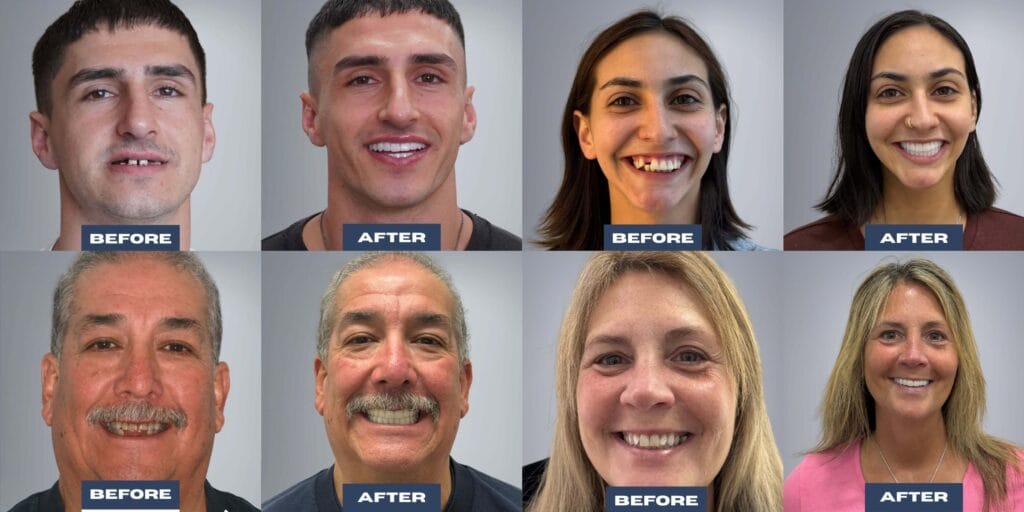
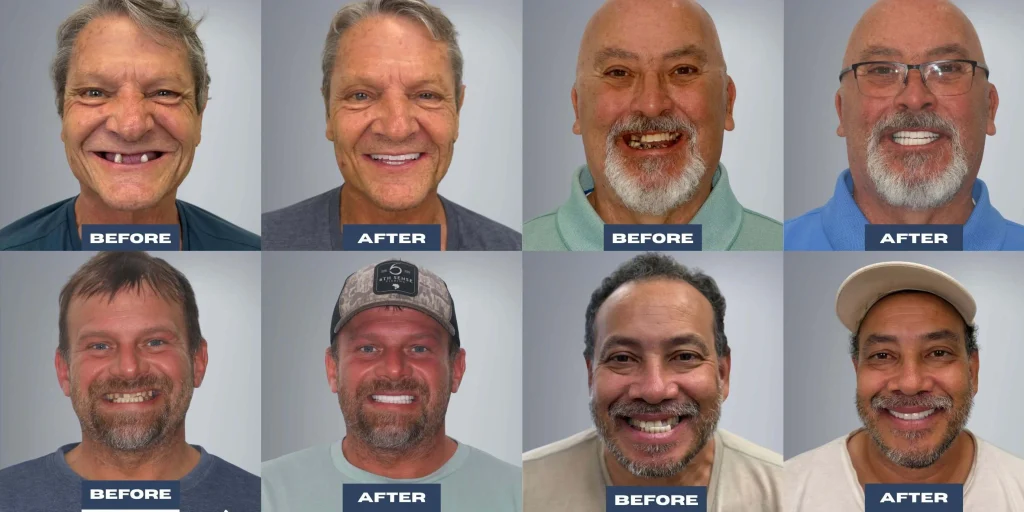
If you’re living with missing teeth, failing teeth, or uncomfortable dentures, you don’t have to decide between All-on-4, All-on-6, or All-on-X on your own.
The first step is determining what your jaw can support and which treatment design makes the most sense for your smile.
At Lasting Smiles Dental Implant Center, advanced 3D imaging, digital treatment planning, sedation options, an in-house dental laboratory, and full-arch implant solutions are brought together under one team.
Schedule your consultation with Lasting Smiles Dental Implant Center to discover which full-arch dental implant option may be right for you.
Your consultation can help determine:
- Whether you’re a candidate for full-arch implants
- How many implants may be recommended
- Whether bone grafting may be necessary
- Whether you may qualify for same-day teeth
- Which sedation options may be appropriate
- Your estimated treatment timeline
- Your personalized treatment cost
- Available financing and payment options
Take the first step toward a strong, confident smile designed to last! See you!
Individual treatment plans, healing times, eligibility for immediate-load treatment, and results vary. A clinical examination and diagnostic imaging are necessary to determine whether dental implant treatment is appropriate for you. Financing is subject to approval and applicable terms.
Share
Recent Articles

Transform Your Smile with Composite Veneers in West Covina | Lasting Smiles
October 21, 2026
Considering composite veneers in West Covina? Discover everything you need to know about costs, same-day application procedures, pros and cons, and how composite...

The Ultimate Teeth Payment Plan Guide: Can Full-Mouth Implants Fit Under $300/Month?
October 14, 2026
Discover how flexible teeth payment plans, 0% APR financing, and low monthly payment options can make full-mouth dental implants fit comfortably into your...
Dental Clips vs Dental Implant vs Dental Bridges: Which Solution for Missing Teeth Fits Your Budget?
October 6, 2026
Deciding between a dental clip, a bridge, or a dental implant? Discover how each option compares in upfront cost, lifespan, maintenance, and long-term...